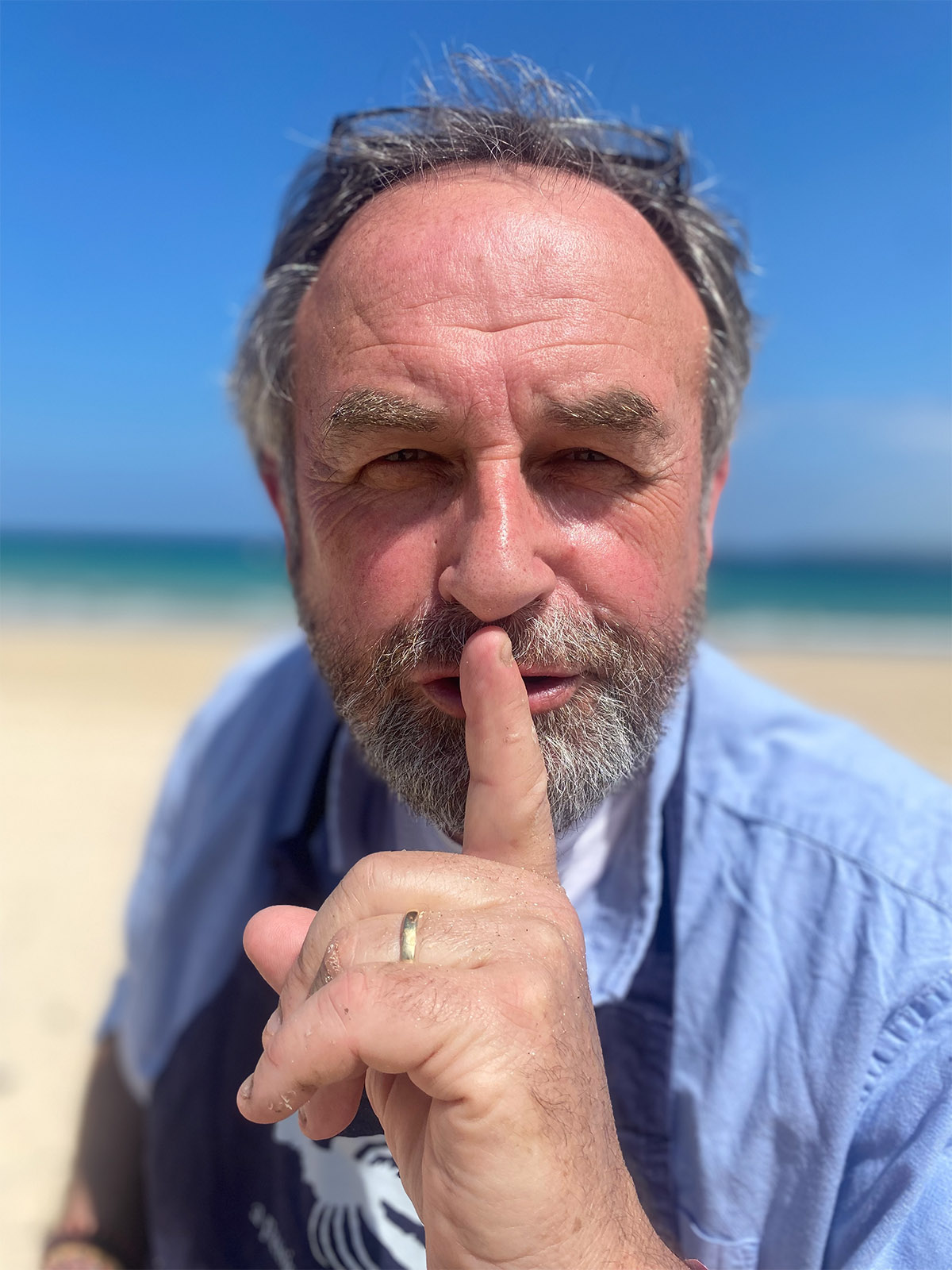
My name is Mike Warner and I’m actually a food writer: a seafood writer and broadcaster.
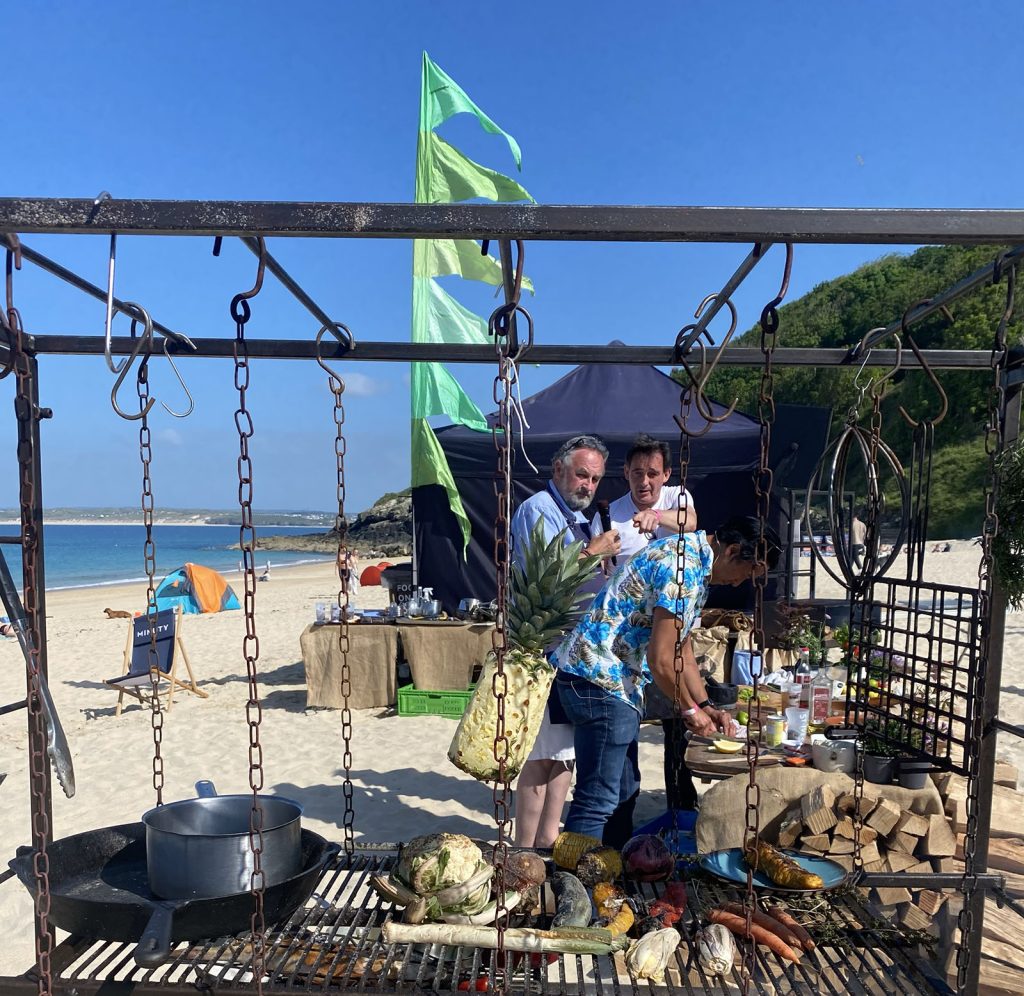
In this seaside episode of The Secret List, we’re chatting with Mike Warner right on the sands of St. Ives during the Food Festival, where he’s just finished an engaging demonstration that had the crowd queuing up like a flock of locusts to taste his impromptu fish stew.
A seafood writer, broadcaster, and passionate storyteller, Mike has spent the last twelve years building his consultancy business that connects producers to consumers, sharing the remarkable stories behind Britain’s incredible seafood. Growing up in a Suffolk fishing community with salt water truly in his blood, Mike made the bold decision at 50 to return to his first love, the sea.
With infectious enthusiasm, Mike reveals the fascinating paradox at the heart of British seafood: we export 80% of our catch to places like the Med and the Far East, while importing most of what we actually eat from as far away as Bangladesh and Vietnam.
The Secret List guide is part of how we create exceptional experiences for guests staying in our Cornwall Airbnb collection. We’re Cornwall’s Airbnb management experts. Learn more >
For the last twelve years I’ve been building up a consultancy business which connects producer to consumer. So really telling the story of how our seafood is produced in the UK and conveying that message to the consumer.
But in a way they can understand. In sort of layman’s terms, to enthuse, to educate, and to inspire to get people to eat more British seafood and to try some of the alternatives that are out there.
It’s been quite a long journey. I started off writing about seafood. My life going back to my childhood where I grew up in a fishing community on the Suffolk Coast very close to a fishing community. I fished from an early age. We ate an awful lot of seafood. As I was growing up, my father fished and I crewed for fishermen. Once you’ve got the salt water in your blood that sigh of the sea never leaves you.
I got to 50 years old having had a career in agriculture and I decided I had to get back to my first love and passion which was seafood, and that’s why I started writing about it. We’ve got a consultancy business and I’m doing things like this now. I’m getting that message out. I’m a storyteller at the end of the day. That’s what I do.
That’s brilliant. I was just listening to your talk in front of everyone on the beach and one of the things you were talking about was the amount that we fish in the UK, the amount of fish that gets exported and the amount of fish that gets imported.
It’s a story close to my heart. I’m lucky enough to have a Sicilian father, Portuguese mother and brought up with seafood. My grandfather was from a lovely spot called Taormina in Sicily. It’s very, very beautiful. We’ve got quite a few friends or family that own restaurants out there. One particularly interesting chap was known as Rosti Mancha, which means roast and eat. He was married to a Scottish lady. And due to this connection, he got into importing lobsters from Scotland.
So, when you go on holiday to Sicily and you go to all these lovely restaurants and see the lobsters in the tanks, he supplied all the restaurants and had a big import business. All of those lobsters in the tanks that people think are local are all from Scotland, and that’s something you were talking about a bit earlier on.
Absolutely right. It’s not just the lobsters. It’s the langoustines. It’s the calamari.
In Brixham in Devon, most of the cuttlefish fishery there is exported to Italy. We’re talking thousands of tons. You never see cuttlefish on a British fish monger’s slab and it’s the same with the langoustines. It’s the same with a lot of our fin-fish species as well, like Megrim Soles and a lot of Hake which is used to go to Spain.
Luckily we’re getting back into trying some of these species in The UK now, and the Hake Fishery especially, in Newlyn, has come on leaps and bounds. But you’re right. 80% of what we catch in the UK is exported all around the world, not just to the Mediterranean. To the Far East, the Middle East, to America.
Then as consumers in the UK, bizarrely and paradoxically, we rely on imports across five species which constitute 80% of our consumption and that’s Cod, Haddock, Salmon, Tuna, and Prawns. That can be coming from as far away as Bangladesh for Prawns. Vietnam, Russia, China for Cod. It’s bizarre. It really is.
Is that because of what’s in vogue or is it a squeamishness, or why for example, do you not see Cuttlefish on the menu here, whereas people are familiar with Squid? Why do you think that is?
I think it’s just a cultural thing. It’s a generational thing as well. Since the second World War, we’ve not eaten a lot of fish as a nation.
Fish and chips seems to be our mainstay. Always has been. And don’t get me wrong I love fish and chips. But again, 90% of the fish and you’ll find in a fish and chip shop is imported. It’s either Icelandic or Russian or Faroese or Norwegian.
Going back to your question, I think we just lost that sort of adventurousness in eating seafood and we haven’t got that connection to the sea and that culture.
It’s interesting, back in 1984 there was a pioneering TV chef, Keith Floyd, who sort of paved the way for Rick and a lot of these other guys like Jamie Oliver and James Martin and all these wonderful chefs who entranced us on tv. Keith Floyd started it all off on his Floyd on Fish program, where he said when it comes to eating seafood in The UK, we’ve lost the nerve of our grandparents. I think, unfortunately, that’s still true today.
We’ve got some amazing restaurants where you can eat the most beautiful seafood in the world in the UK. But as consumers, generally, going to supermarkets, we’re going to eat Salmon and Tuna and Prawns and there’s so much more to it than that.
It’s a real shame. Funnily enough, speaking of Keith Floyd, I had a lot of fond memories of him and just watching how much wine he used to drink while he was cooking, that was his big trademark.
I tend to my model myself a bit on him, certainly from the wine side of it. I do like to have a glass of wine while I’m cooking, but it’s a lot of fun and I like to make my demonstrations as interactive as possible and get people asking questions. There’s nothing scripted; it is what it is. You saw what happened today, things happen, and we ended up with an amazing sort of fish stew which, like a flock of locusts, people have lined up to try and taste at the end and it’s all gone very quickly.
It has all disappeared.
And so, talking of food and eating out and Cornwall, if you’re thinking I want to go out with some friends or family. What would be your top three recommended places to eat in Cornwall?
Well, I’ve done a lot of work in Cornwall over the years. I’ve got a lot of friends here who are chefs and I’ve spent an awful lot of time in Cornwall and an awful lot of time eating sea food, which has been amazing.
That sounds very, very hard.
It’s an awful life. Trouble is, a lot of it’s been at my expense, so it doesn’t often pay for it very well. But having said that, the knowledge I’ve gained from chefs and from fishermen alike and making that sort of net to plate connection has been amazing.
I would first have to take you to Newlyn to a great mate of mine Ben Tunnicliffe, who cooks at the Tolcarne Inn.
We were there last night actually, and I’ve never ever had a bad meal with Ben at the Tolcarne. He buys off Newlyn Market. It comes straight from the harbour, meters away, and he cooks in such a lovely, natural, old-fashioned way but just bringing out seasonal flavours in the simplest of fashions. I had Cornish Hake last night with a hollandaise and crushed Cornish early potatoes with a tartar sauce and tartar mayonnaise and fresh Cornish asparagus. Absolutely superb. That would be my first port of call.
You’ve made me very hungry already. What about a couple of others?
I’m also very friendly with Nathan Outlaw up in in Port Isaac. There are two. You’ve got his Fish Kitchen down on the harbour, which is fantastic for a really lovely lunch with an amazing backdrop of the cove at Port Isaac. If you want a really good tasting menu experience, then go to Outlaws at New Road because it’s a different experience. Nathan has three Michelin stars. I don’t need to say anymore.
He knows his fish. He knows the fishermen. He buys from a mate of mine, George Cleave, who’s part of a Port Isaac fishing family. A young fisherman, young fish merchant, and the quality is unsurpassed. It’s not cheap. You have to prepare for it and go and be open minded to have an afternoon there overlooking looking the Atlantic and have probably one of the finest experiences of your life.
That’s very tasty! Very useful for people to experience a whole range of different dishes in one sitting. And what about if you go for a drink in Cornwall? Where would you go to?
You’ve got a drink there and we’re on a beach and that’s a fantastic place to have a drink.
It’s a great place to have a drink. Again, I would go back to Newlyn. I’ve spent so many hours talking to fishermen over the years and so many funny stories and dare I say, getting quite drunk with them as well. Newlyn is second home to me and every time I go there, I stay at the Swordfish Inn. For me grabbing a pasty from Warren’s Bakery and sitting outside with a pint of Tribute with a few friends, is heaven.
You don’t need many things to keep you happy, do you? Just sometimes the simplest things and a bit of good company make the perfect day.
100%. It’s amazing where the time can go to with a pint and a pasty and some really good humour. It’s great. I’ve got so many friends down there now. There are so many places you can go in Cornwall to have a have a good time. There are so many lovely pubs and venues, where you can go.
It’s just food heaven.
It is. You’ve spoken a lot about Newlyn and it’s a place with such a lovely character. It has a really nice feel to it. So, if you visit Cornwall, you should definitely go down there and get the vibe.
But if you wanted to buy some fish in Newlyn, there are a lot of places that you can buy them from. Anywhere in particular that someone should head or just have a look and see what tickles their fancy?
Havea look. The beauty of Newlyn is it’s a sort of smorgasbord of seafood. You’ve got Trelawny Fish. You’ve got Stevenson’s, now owned by Ocean Fish. Both have fantastic fish counters there. You’ve the pick of prime Cornish produce there.
So that would be the place to go if you’re wanting to get fish to cook at home. Definitely head to those two places. But then there are other good fishmongers as well. There’s Matthew Stevens here in St. Ives, Wing of St.Mawes. There are some really top places and top fishmongers who will give you all the recommendations.
I think also what I’ve definitely found is, if you to the fishmongers and you’re looking at the fish and you sort of have something in mind but you’re not quite sure or you’re a little nervous about it, they’ll be really helpful. They’ll tell you how to cook it, quite precisely, and they’ll really simplify it so that that you could take something home. They’ll prepare it for you. They’ll do everything you need and they make it very, very easy for you, don’t they?
100%. That’s the good thing about British fishmongers, is that there’s no question which is out of bounds. Ask them anything because fish cookery is essentially incredibly simple. Less is always more. People are reticent about prepping fish. So, if you don’t want to prep the fish yourself or you don’t know how, get the fishmonger to do it for you.
He’ll tell you where it’s come from, how it’s been caught, why it’s been caught, when it’s been caught. So, you’ve got the provenance as well and don’t feel too nervous about it because it’s not that difficult.
Brilliant. And finally, just to wrap up, a tip for people visiting Cornwall or people that are in Cornwall. Something to experience that they might not ordinarily think of?
If we keep the fishy theme going, I’ve just launched an initiative which is mainly for hospitality in the media, but it’s something called Quay Connections.
What we do is we take people on harbour trips and visits of Newlyn Fish Market and the port. We get them aboard a vessel. We get them talking to fishermen. We visit a processor. We go to the lobster hatchery. We go to Fishy Filaments, who’s the guy who makes different plastics out of recycled nets. We talk about the sustainability. Not just of the fish stocks themselves, but of the fishing community and how important all the allied industries are, because every fisherman has about 15 other guys standing behind him in support. That’s true balance and sustainability within a community. And Newlyn is a shining example of that.
So, come on one of my Quay Connections tours and see for yourself exactly what happens below the surface.
Thanks for that. It sounds like a lovely way to experience a different side of Cornwall and get some insights and stories that you might not ordinarily hear of.
Absolutely. That’s what it’s all about. It’s all about educating, enthusing, and informing.